

Tough Grease Problems: Solutions for Industrial Cleaning
Industrial grease buildup is a serious issue. From slippery floors to machinery failures and clogged drains, grease can lead to accidents, equipment breakdowns, and costly downtime. The right cleaning methods and products are essential to maintaining safety and efficiency.
Key Takeaways:
- Machinery: Grease causes coating failures, weld cracks, and equipment corrosion. Proper degreasing prevents expensive repairs.
- Floors: Greasy surfaces increase slip-and-fall hazards and can lead to OSHA violations.
- Drains: Grease clogs can flood systems, requiring frequent maintenance or risking health code penalties.
- Food Equipment: Baked-on residues demand specialized cleaning to avoid contamination and failed inspections.
Solutions:
- Hot Water Pressure Washing: Effective for machinery and floors, using water at 180–200°F.
- Citrus-Based Degreasers: Eco-friendly and safe for grease traps.
- Foaming Cleaners & Scraping: Ideal for vertical or intricate surfaces.
- Enzyme Treatments: Breaks down grease in drains and traps while preventing odors.
For a reliable option, Made Here Co.'s Power Degreaser offers a powerful, American-made solution. Its advanced formula handles tough grease on various surfaces, ensuring compliance with safety standards while protecting equipment. At $15.99 for a 32 oz bottle, it’s a cost-effective choice for industrial cleaning.
Common Industrial Grease Problems
Grease buildup in industrial settings can lead to both operational hiccups and financial burdens. Recognizing these challenges is the first step toward implementing effective cleaning strategies. Each issue calls for a specific approach tailored to the affected area.
Grease Buildup on Machinery and Equipment
When machinery gets coated in grease, the consequences can be severe. Poor degreasing practices may cause coating failures, weld cracks under stress, and even short-circuits in sensitive electronic components. For electronics, residues like fingerprint oils and flux can lead to electrical leaks or dendrite growth, which can corrode equipment from the inside. Even when surfaces appear clean, petroleum-based oils, cutting fluids, waxes, and adhesive residues often leave behind organic films. This is why aerospace manufacturers demand perfectly clean surfaces - especially on titanium and composite materials - to ensure safety during flight. These risks illustrate the importance of thorough degreasing to extend the life of machinery and prevent costly failures.
Grease on Floors and Work Surfaces
Grease doesn’t just stick to machinery - it also finds its way onto floors and work surfaces, creating a host of problems. On floors, grease and oil spills are a major safety hazard, increasing the risk of slips and falls. These incidents not only endanger workers but could also result in OSHA violations if not addressed. On work surfaces, grease can form stubborn grime that resists basic cleaning methods. This grime can transfer to tools and workers, complicating maintenance tasks. Tackling grease on floors and surfaces is essential to maintain safety and keep operations running smoothly.
Grease Clogs in Drains and Traps
Drain clogs caused by grease are another common issue, typically affecting three areas: plumbing backups from incoming lines, grease trap flooding from outgoing lines, and overflow in crossover lines due to debris buildup. As grease cools, it solidifies and adheres to the walls of drainage systems. Left unchecked, these blockages can lead to sewage backups in kitchens, workspaces, or even parking lots, forcing operations to shut down immediately. Cleaning industrial grease traps can cost between $115 and $1,040 per service, with larger traps needing pumping every 4 to 6 weeks to avoid severe blockages. Andrew Glancy of Grease-Cycle emphasizes the stakes:
If you fail to resolve the problems behind the clogging, you could face a health code violation. This arises from an unsanitary environment. It could even lead to the closure of your business.
Proactive maintenance of drains and traps is key to avoiding expensive shutdowns and regulatory penalties.
Baked-On Grease in Food Processing Equipment
Food processing facilities face a unique challenge: baked-on residues like fats, proteins, starches, and mineral deposits (commonly known as "milkstone"). These hardened deposits accumulate on ovens, fryers, and other equipment, posing sanitation risks and hindering operations. Unlike fresh grease, these deposits require specialized cleaning. Alkaline treatments heated to 160–180°F chemically transform the fats into water-soluble soap through a process called saponification. Afterward, acid rinses are needed to remove mineral scale. Failure to clean this equipment properly can lead to microbial contamination and failed health inspections. These challenges highlight the need for advanced cleaning methods in food processing environments.
Effective Methods for Removing Heavy Grease
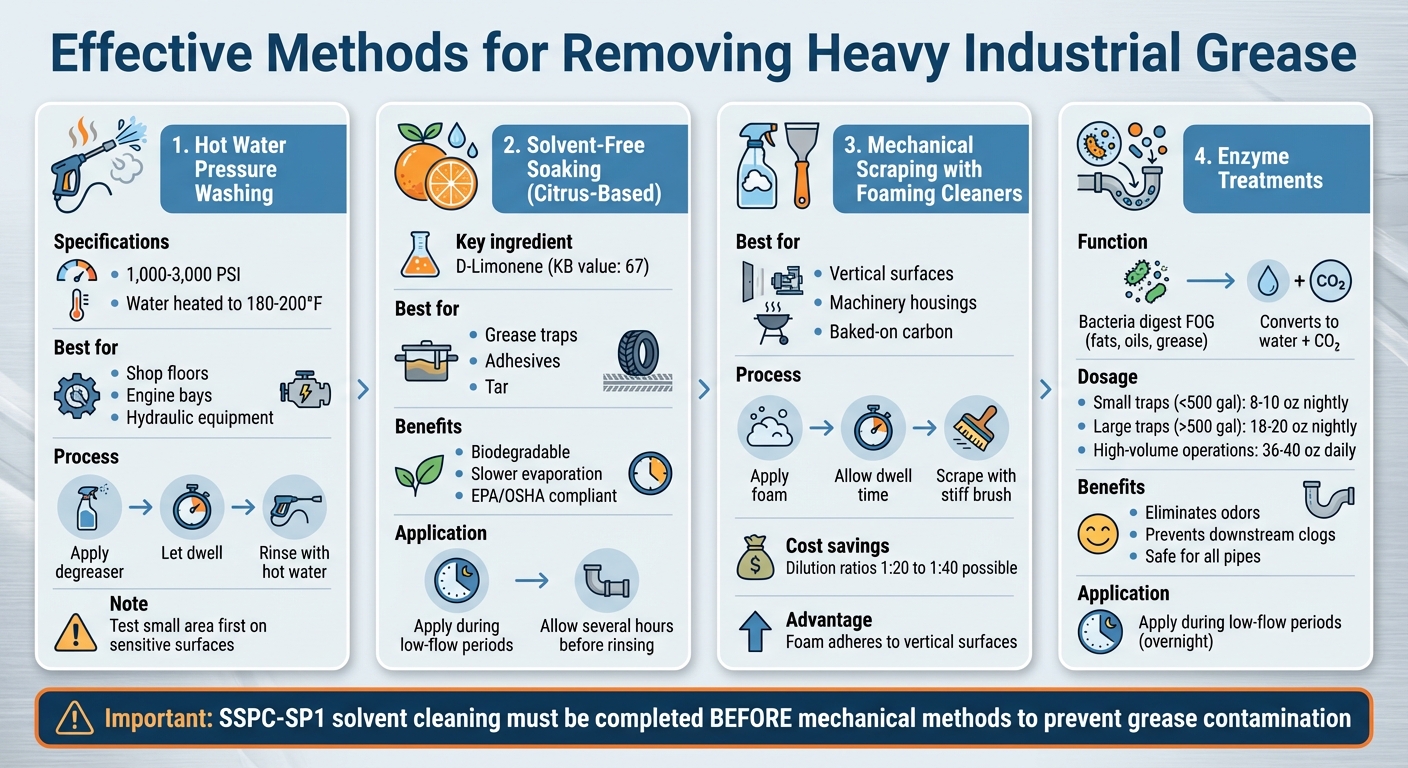
4 Effective Methods for Removing Heavy Industrial Grease
Picking the right approach for dealing with heavy grease is crucial. Before jumping into mechanical cleaning methods like blasting or scraping, it's essential to start with solvent or chemical degreasing.
This initial step ensures grease doesn’t get embedded deeper into the surface, which could compromise coatings or repairs later. The methods below outline practical strategies for industrial degreasing and tackling grease in various settings.
Hot Water Pressure Washing
Using industrial hot water pressure washers with 1,000–3,000 PSI and water heated to 180–200°F is a powerful way to remove grease. This method is particularly effective on shop floors, engine bays, and hydraulic equipment, where grease can range from fresh to moderately aged. Tyler Grantham from Hydra Force Power Washing explains the process:
The most effective method is: 1. Apply degreaser to break down oil 2. Let it dwell 3. Rinse with hot water to melt and flush it away.
Hot water works especially well in cold environments, as the heat softens hardened grease quickly. However, always test a small area first to ensure sensitive surfaces aren't damaged by the high pressure. This approach is ideal for large-scale industrial grease removal.
Solvent-Free Soaking for Grease Traps
Citrus-based degreasers containing D-Limonene (with a KB value of 67) are a safer alternative for breaking down grease, adhesives, and tar. These biodegradable products avoid the risks associated with petroleum solvents and are perfect for soak applications due to their slower evaporation rate . They’re also gentle on pipes and meet environmental standards for wastewater runoff.
For best results, apply the degreaser during low-flow periods, allowing several hours for it to work before rinsing. This eco-conscious method aligns with EPA and OSHA standards and is a practical solution for maintaining grease traps.
Mechanical Scraping with Foaming Cleaners
When grease has aged into stubborn, compacted layers, combining manual scraping with foaming cleaners provides excellent results. Foaming cleaners stick to vertical surfaces, giving the surfactants time to break down the grease. Once the foam has done its job, stiff brushes or scrapers can be used to remove the loosened material.
This technique works particularly well for machinery housings, tools, and equipment with baked-on carbon or petroleum buildup. Additionally, some highly concentrated degreasers can be diluted at ratios of 1:20 or even 1:40, making them cost-effective for large-scale cleaning tasks. This method is especially effective for vertical and intricate machinery surfaces.
Enzyme Treatments for Organic Grease
Biological treatments use enzyme-producing bacteria to digest fats, oils, and grease (FOG) in drain systems and grease traps. Unlike chemical solvents that simply melt grease, these bacteria convert organic matter into water and CO₂. This not only clears clogs but also prevents grease from traveling further into wastewater systems, reducing compliance risks.
For smaller grease traps (under 500 gallons), apply 8–10 ounces of treatment nightly. Larger traps (over 500 gallons) may require 18–20 ounces, while high-volume commercial operations may need 36–40 ounces daily . Apply the treatment during low-flow periods, like overnight, to maximize contact time. Beyond clearing grease, these treatments eliminate odors and are safe for all pipe types, making them a great choice for food processing environments. This method offers long-term savings on maintenance and ensures reliable system performance.
sbb-itb-e492565
Made Here Co.'s Power Degreaser for Industrial Use
Made Here Co.'s Power Degreaser is a tough, American-made cleaning solution designed for industrial settings. Originally created for the oil and gas industry, it’s built to handle the most stubborn grease, oils, and adhesives on equipment and surfaces.
Safe for Multiple Surface Types
One of the standout features of Power Degreaser is its versatility. It’s safe to use on a variety of surfaces, including metals, plastics, and more. Whether you’re cleaning machinery, shop floors, or processing equipment, its multi-surface compatibility makes it a go-to option for industrial and commercial applications.
Performance Across Grease Types
Not all grease is the same, and the Power Degreaser adapts to different challenges. Lighter contaminants may require less contact time, while tougher buildups might need a bit longer. Be sure to follow the provided instructions to get the best results every time.
How to Use Power Degreaser in Different Settings
Cleaning Heavy Machinery
When using Made Here Co.'s Power Degreaser on heavy machinery, start by testing it on a small, hidden area to ensure it won't harm paint or plastic parts. For spot cleaning, spray the degreaser directly onto the greasy surface and let it sit to loosen the grime. For tougher buildup, a light scrub before rinsing can make a big difference. If you're dealing with extensive grease, try pressure washing with heated water at pressures between 1,000 and 3,000+ PSI for thorough cleaning. To confirm the surface is clean, you can use the Water-Break Test (ASTM F22): if water spreads evenly without forming beads, the surface is free of organic residue.
"An improperly degreased surface is a guarantee of failure. ... If the substrate is not professionally degreased and prepared, you are building on a foundation of sand." - Andre Taki, Lead Product Specialist, Alliance Chemical
These same cleaning principles can also be applied to drains and floors to prevent grease-related issues.
Maintaining Drains and Grease Traps
To keep drains and grease traps clear, dilute the degreaser according to the manufacturer's instructions. Pour the solution into the drain or trap and let it sit for 5 to 30 minutes to break down grease deposits. Afterward, flush the system with hot water (160°F to 180°F) to wash away dissolved grease and any leftover chemicals. Always check the type of buildup beforehand to ensure the cleaning process is both safe and effective. This method complements the cleaning techniques used on machinery and floors.
Preventing Grease Buildup on Floors
Industrial floors can be kept safe and slip-free with a regular cleaning routine. A water-based degreaser like Power Degreaser is especially effective when paired with a floor scrubber. Spray the degreaser across the floor, let it sit briefly, and then scrub the area with a brush or mechanical scrubber for heavy buildup. Rinse thoroughly with water to remove residue. If your floor has a specialty finish, check compatibility before applying the product.
Safety Precautions for Industrial Applications
Safety is key when working with degreasers. Always wear chemical splash goggles and gloves - nitrile for light hydrocarbons or butyl rubber for stronger solvents - to protect your skin. Ensure you're in a well-ventilated area, and use local exhaust ventilation for concentrated tasks. Keep Class B fire extinguishers within 50 feet and avoid open flames. When transferring liquids, ground and bond all containers to prevent static discharge. Following these precautions ensures a safer work environment while handling industrial cleaning tasks.
Conclusion
Industrial grease issues - like machinery buildup, slippery floors, baked-on grime, and clogged drains - aren’t just inconvenient; they pose serious safety risks and operational challenges. Regular degreasing is a must to prevent costly equipment breakdowns and maintain a safe workplace.
The method you choose to clean matters. Techniques like hot water pressure washing, mechanical scraping with foaming cleaners, and enzyme treatments all have their place, but a reliable, all-purpose degreaser makes the job much easier. Made Here Co.'s Power Degreaser is a standout option. Using Nano Technology, it removes grease from various surfaces without the flammability or harsh fumes typical of solvent-based cleaners. At just $15.99 for a 32 oz bottle, it offers professional-grade cleaning power that’s safe for heavy machinery, painted surfaces, and floors.
Opting for American-made products like Power Degreaser isn’t just about effective cleaning - it’s about supporting products crafted under strict U.S. safety and environmental standards.
When you buy domestically manufactured industrial cleaners, you’re also investing in local economies and skilled labor. Made Here Co. reflects this commitment by combining cutting-edge formulas with the dependability of U.S. manufacturing.
In short, tackling tough grease doesn’t mean sacrificing safety, surface care, or your values. With the right tools and a consistent cleaning routine, you can keep your facility running smoothly while supporting American workers and innovation.
FAQs
Which degreasing method should I use for my specific grease problem?
The best way to tackle grease removal depends on the type of grease and the surface you're cleaning. If you're dealing with heavy, baked-on grease on metal surfaces, solvent-based degreasers are your go-to choice. For general cleaning or areas like food prep environments where safety is a priority, water-based degreasers are a safer alternative. When it comes to machinery or equipment with stubborn grease buildup, alkaline degreasers are highly effective. Your choice should align with both the cleaning requirements and any safety concerns.
How long should a degreaser dwell before rinsing?
Allow the degreaser to sit for around 15 minutes before rinsing, especially when dealing with stubborn grease stains. This waiting period lets the product work its magic, breaking down tough grease and making it much easier to wash away.
Will Power Degreaser damage paint, plastics, or floor finishes?
Power Degreaser is crafted to tackle grease effectively while being gentle on surfaces such as paint, plastics, and floor finishes. When used as instructed, it works safely across various materials, delivering thorough cleaning without risking surface damage.
